


Design Thinking
PLAN
Building a shared understanding and vision!
Course Content for ENT3607 Innovation by Design - Syllabus
Design Thinking > How Might We > Team > Plan > Empathize > Synthesize > Reframe > Ideate > Select > Build > Pitch
In the Planning stage we gather basic information about the Design Challenge that will guide the Empathy Research.
We are not yet considering solutions!
The Planning Stage of Design Thinking involves analyzing three important aspects of the problem prior to Empathy Research:
Stakeholders - People impacted by the design challenge directly and indirectly. This includes the primary stakeholder who is the person you are primarily attempting to help, and other stakeholders that are connected to the primary stakeholder and problem they are facing.
Context - The environment in which the problem exists. Particularly trends that impact the problem and stakeholders in areas of Technology, Society, and Economics.
Success Factors - Factors of the problem that need to be addressed in order to achieve success. Consider how you might define success after your solution is applied.
Understanding these three aspects of the problem will allow you to intelligently plan your research and guide you in determining the impact of your solution once it is developed.
Activities
-
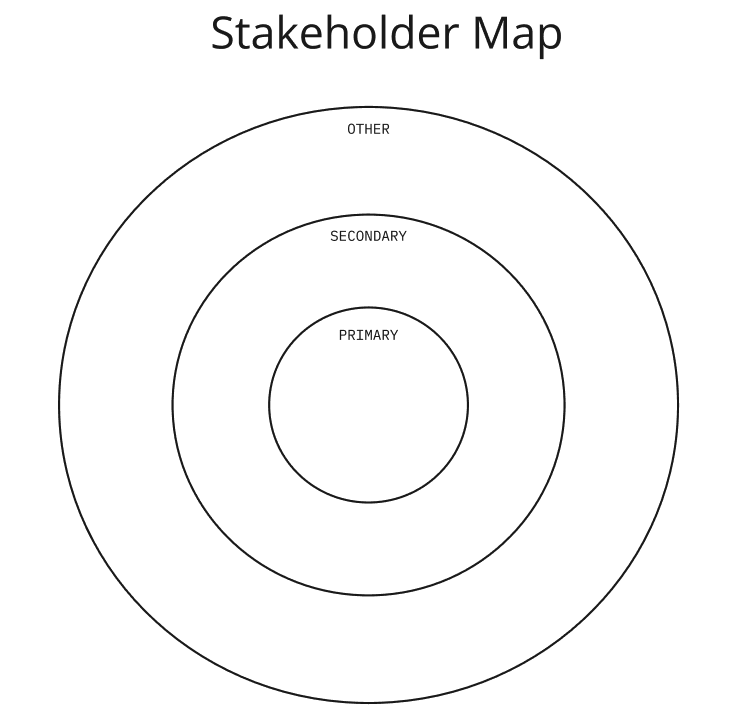
Create A Stakeholder Map
In-class team activity
Estimated Time: 10-15 minutes.Use sticky notes on a virtual or real Stakeholder Map (shown above) to identify stakeholders impacted by the problem. All group members should work independently to add sticky notes with stakeholder names written on them to the target diagram while discussing your ideas and thoughts. Note:
There can only be ONE Primary Stakeholder - for example “First Year College Students”
Secondary Stakeholders are strongly impacted by the problem (and potential solution) but not your main concern - for example "Parents of Students"
Other Stakeholders are not significantly impacted but are involved - for example, "local business owners."
Stakeholders should be people you can actually visit and interview. For example, “Local Government” isn’t a stakeholder, but “The Mayor” could be. The more specific you are, the better.
When finished, work together to discuss your sticky notes, position them appropriately, and remove duplicates. The value of this exercise is in the discussion it generates. Write key questions, discussion points, and insights that arise on sticky notes and post on the side of or below the target diagram.
-
GenAI - What have we overlooked?
Login in to your FSU Google account.
Access the Google Gemini prompt.
Take a screenshot of your Stakeholder Map and upload it to Gemini using the + button.
Inform Gemini of your HMW and ask it if you have overlooked any stakeholders. Consider it’s suggestions and add more stakeholders to your map.
Example: My team and I are using Design Thinking to explore the following challenge "How Might We ……."
We have identified stakeholders associated with this problem in the included screen shot. What stakeholders have we overlooked?
-
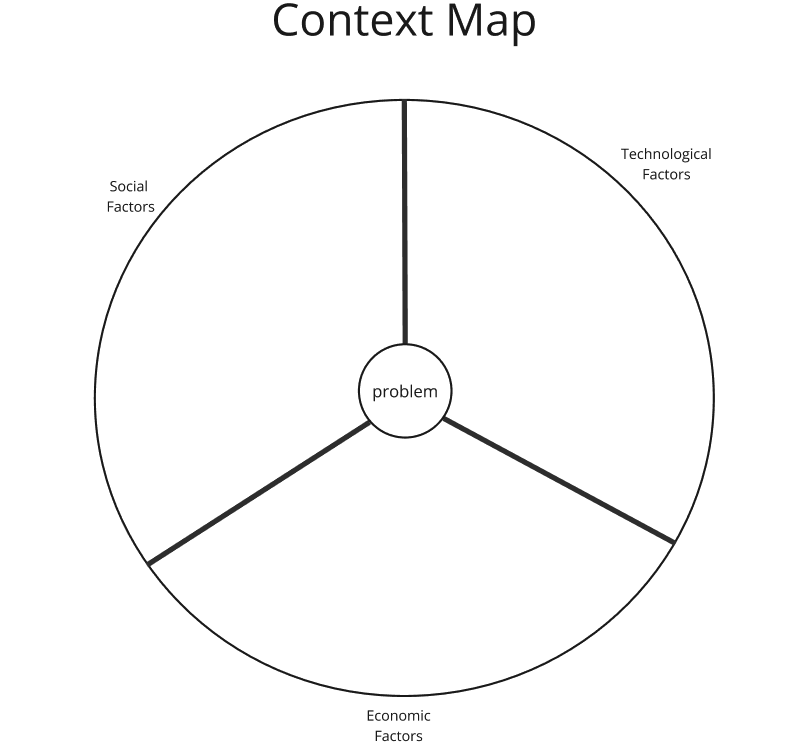
Create a Context Map
In-class team activity
Estimated time: 10-15 minutesUse sticky notes on a virtual or real Context Map (shown above)to identify factors and trends that impact the problem. Stick your problem on a note at the center of the map. All group members work independently to add sticky notes to the map with factors and trends written on them while discussing your thoughts and ideas.
- Technology Factors might include items like Agentic A.I. or LinkedIn Learning
- Social Factors might include items like the political divide or peer pressure
- Economic Factors might include the cost of education or a lackluster job marked.
Check with Gemini to see if you have overlooked any important contextual trends associated with your HMW.
When finished, discuss your sticky notes. What do you think are the most important factors and trends to pay attention to in your research? Mark them with a star!
-
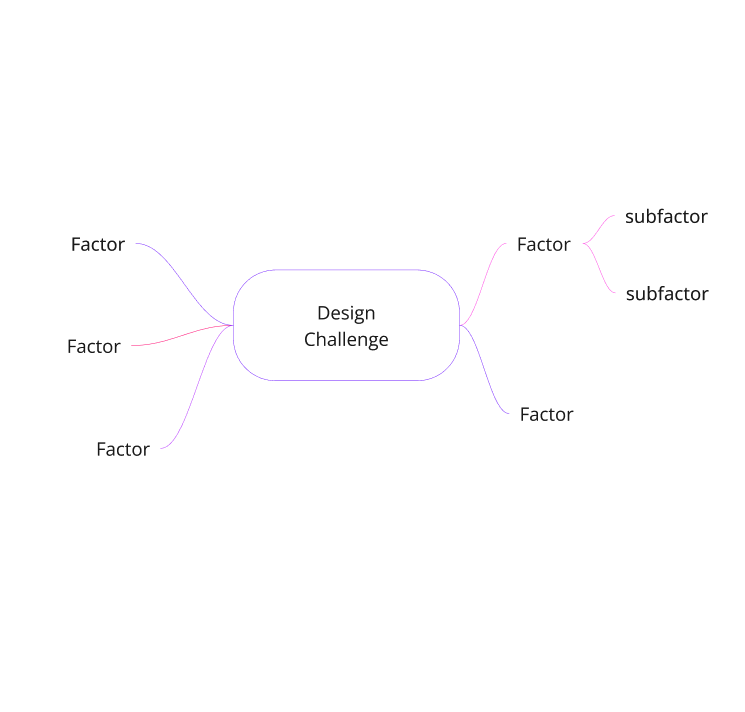
Create a Success Factors Mind Map
In-class team activity
Estimated time: 15 minutesCreate a mindmap that identifies all aspects of the problem that need to be addressed if you are to succeed in fixing it. Place the problem at the center, then work outward identifying the most general factors, then the subfactors of those. You can go as deep as you care to until all aspects and factors of the problem are identified.
When finished, discuss the factors that are most important to understanding the problem and developing a successful solution.
Caution! It’s too early to discuss serious solution proposals. You need to thoroughly understand the problem first!
Check your understanding of Planning
Stakeholders are only those who are the victims of a problem. (T/F)
Stakeholders are entities and organizations like “The US Government” and “The Automotive Industry” (T/F)
These can be only one primary stakeholder. (T/F)
It is important to analyze the __________ of the problem to understand the social, technological, and economic trends that impact the problem.
_________________ are the aspects of the problem that must be addressed if the problem is to be fixed.
What tool of those described in the activities above, is best designed for visually analyzing a complex topic such as success factors by identifying multiple levels of topics and subtopics?
Resources
Videos
Make Sense of this Messy World - Mind Maps (Explained by a Google Strategist)
https://www.youtube.com/watch?v=kySIsX01l3U&t=2s