
Before Session 3 · What Is College For?
Read this before class — 15 to 20 minutes. At the end: a journal prompt and the one sentence you're bringing. Your triad hears it first.
The big idea: you already have an answer — but is it yours?
Ask ten people what college is for and you'll get ten confident answers. To get a good job. To find yourself. To make connections. Because it's what you do after high school. Here's the strange part: almost nobody can tell you where their answer came from — and yet that answer is quietly steering thousands of their hours and dollars.
Burnett & Evans say that before you can design anything, you need to know what you believe it's for. Their tool for this is called a view — a short, written, honest statement of your working philosophy of a thing. In their book it's a Workview: what is work for, why do it, what makes good work good. FSU's version of this course adds one designed for exactly where you are: the CollegeView. What are these four years actually for — for you, not for the brochure, not for your aunt at Thanksgiving?.
Two things make a view different from an opinion. First, it's written down — vague ideas survive in your head forever, but they have to sharpen the moment they hit paper. Second, it's yours — which is harder than it sounds. Most of what we believe about college arrived secondhand: from family, from rankings, from movies, from the economy's anxiety, from a guidance counselor's poster. None of those sources is bad. But a view you absorbed without examining is other people's steering wheel in your hands. Burnett & Evans are blunt about the alternative: if you can write down your own philosophy of what this is for, you become much harder to steer.
Michael follows the plan

The book tells the story of Michael — a happy, popular kid from a small California college town who never spent much time planning his future, because his mother did it for him. She planned for college. She chose where he'd apply. She even chose his major: civil engineering. Michael wasn't especially interested in civil engineering, but he wasn't opposed either, so he followed the plan. He did fine. He graduated. He fell in love, followed her to Amsterdam, took a perfectly good engineering job there, then followed her back to California and took another one.
Notice what's missing from that story: Michael. At no point had he stopped to ask what he wanted or who he wanted to become. He had never written down a view of anything. Other people steered, and it worked — right up until it didn't, which is where his story picks up again in Week 5. For now, the question his first chapter leaves us with is the one this week is built on: whose plan are you on? Not as an accusation — Michael's mom loved him, and the plan wasn't crazy. As a genuine question, the kind a designer asks about the current state before changing anything.
Four things college can be for — at the same time
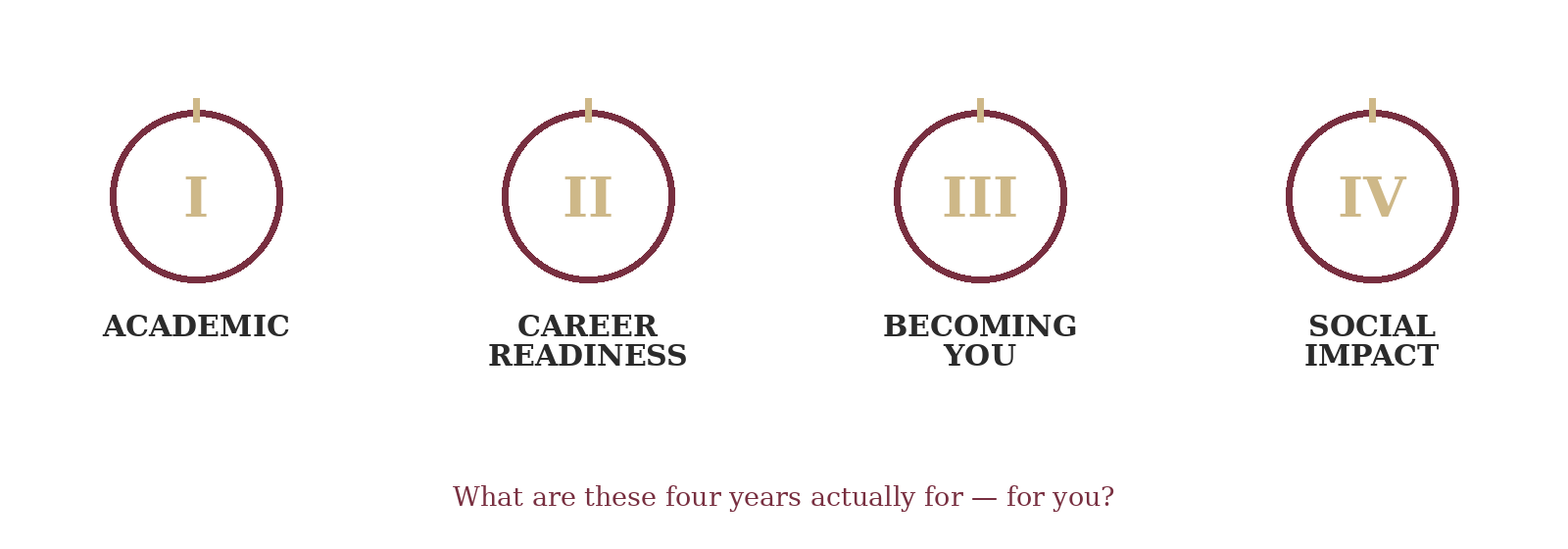
One reason “what is college for?” feels hard is that it has several true answers at once, and people argue as if you have to pick one. FSU's Engage 100 program names four dimensions, and they make a useful set of lenses for your draft:
Academic. Learning things — for use, and also for the strange joy of understanding something you didn't understand last month.
Career Readiness. Building toward work — skills, credentials, experiences, and a sense of what kinds of work might fit you. Real, and not the whole picture.
Becoming You. The person you're turning into while all of this happens — which is arguably the biggest thing these four years produce, and the one no transcript records.
Social Impact. What your education makes possible for people who aren't you — family, community, the problems you might spend a life on.
Your CollegeView doesn't need all four in equal amounts — remember the dashboard rule from Week 1: no symmetry. But it's worth noticing which dimensions your current answer lives in, and which ones it hasn't even considered. A first draft that's 100% Career Readiness isn't wrong. It's just probably borrowed — that's the answer the economy hands every eighteen-year-old at the door.
How to write your own view
A view is a strange kind of writing — you're not arguing with anyone, impressing anyone, or getting graded. So the usual school-writing instincts all point the wrong way. Three moves that help, and you'll use them again for the Workview and Lifeview next week:
Write like you talk. If a sentence sounds like a scholarship essay, cross it out and say the same thing the way you'd say it to your roommate at midnight. “College is for maximizing my potential” is a poster. “I want to leave here able to do something my family can't do” is a view.
Borrow, then edit. If a blank page freezes you, don't fight it — write down the borrowed answer first, in full, and then argue with it in writing. Cross out what isn't yours, keep what survives, add what's missing. Editing a borrowed view is a completely legitimate way to find your own; most people's real beliefs first show up as objections.
Push on your own sentences. When you write something that sounds good, ask it one question: would I still believe this if it cost me something? “College is for making connections” — would you skip a class you loved for a networking event? If yes, that's really your view; own it. If the thought makes you a little sick, your real view just spoke up. Write that one down instead.
And a promise about size: a first draft is a few honest paragraphs, not a manifesto. Burnett & Evans size the written views at about 250 words — half a typed page — precisely because a view you can hold in your head is one you can actually navigate by. Yours will change over the next four years. It's supposed to. This is the first reading of an instrument you'll recalibrate for the rest of your life.
This week's belief → reframe
The belief that gets people stuck: “There's one right answer to what college is for — and everyone else seems to know it.”
The designer's reframe: There are many good answers. The only bad one is a borrowed answer you've never examined — and after this week, that won't be yours.
Your journal
Before class, one entry: take your first-draft sentence — your answer to “what is college for?” — and interrogate it kindly. Where did this answer come from? Whose voice does it sound like when you say it out loud? What would your answer be if nobody ever found out what you picked? You're not required to change your answer. You're required to know where it came from.
Come Ready
You already know this one from last class: your one-sentence answer to “what is college actually for?” First draft — it's allowed to be wrong, it's allowed to sound like your parents. Bring it, and bring one more thing from your journal: a guess at whose voice it sounds like. Your triad opens with both.
ENT 1611 Designing Your Life · FSU Innovation Hub · The line: Conscious Leadership Group; vulnerability research: Brené Brown, Daring Greatly (2012); gravity problems: Bill Burnett & Dave Evans, Designing Your Life (Knopf, 2016) · Worksheets and submissions on Canvas