
Before Session 2 · Above or Below the Line?
Read this before our first class — give it 15 to 20 minutes, somewhere you can think. At the end you'll find a journal prompt and one thing to come ready with. Your triad will be counting on it in the very first activity.
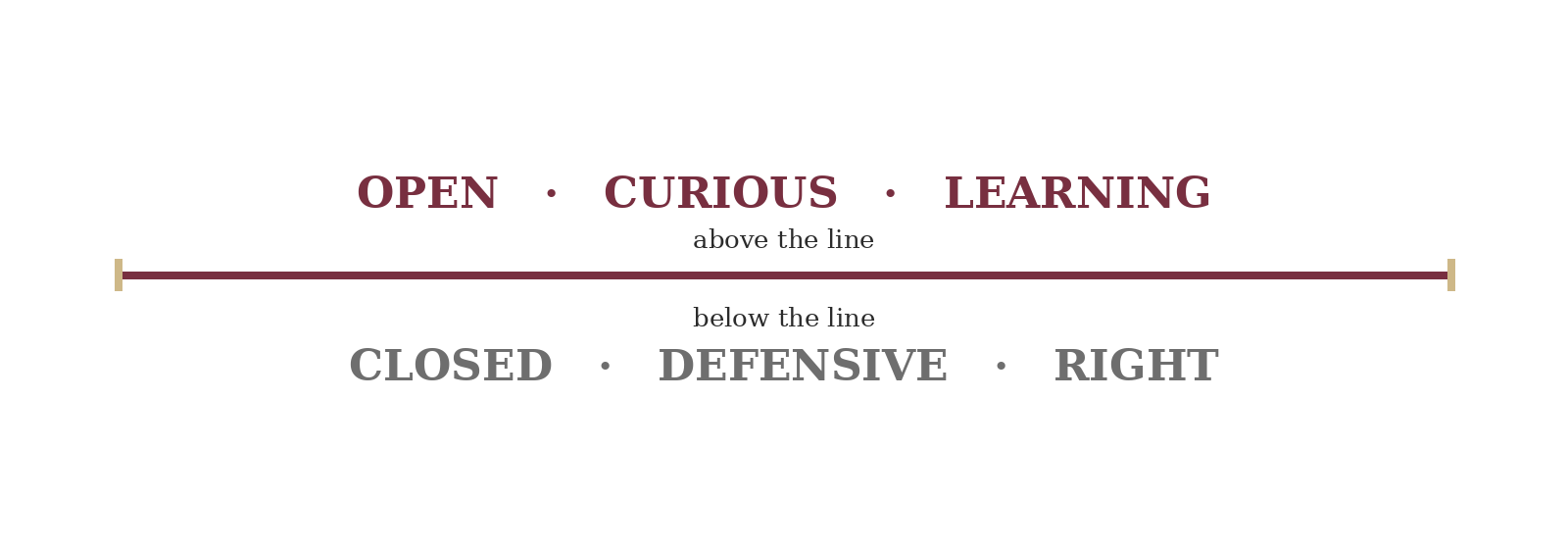
The big idea: locate yourself before you decide anything
Last week, Burnett & Evans gave us the designer's starting move: begin where you actually are. This week we add a tool that makes that possible in real time — because “where you are” changes many times a day, and most of the time you don't notice it happening.
The tool comes from the Conscious Leadership Group, and the idea is a single horizontal line. At any given moment, you are in one of two states. Above the line, you are open, curious, and interested in learning — you can hear feedback, consider new ideas, and be wrong without it feeling like an emergency. Below the line, you are closed, defensive, and interested mainly in being right — you explain, you justify, you blame, you replay the conversation with better comebacks. Everyone lives on both sides of this line, every single day. This course calls the practice of checking which side you're on locating yourself.
Here is the part that surprises people: being below the line is not bad, and it is not a character flaw. Brené Brown, who has spent her career researching how people handle vulnerability, is direct about this — dropping below the line is a normal, human, protective response, and everyone does it constantly. The Conscious Leadership Group says the same thing: the goal is not to live above the line all the time. Nobody does. The goal is to notice where you are. That's the entire skill. Because the moment you notice you're below the line, something changes — you now have a choice you didn't have three seconds earlier.
This is why you can't skip this week and get to the exciting design tools. Every tool in this course — the compass, the Odyssey Plans, the conversations — requires curiosity to work. And curiosity only lives above the line. Try to reframe a problem while you're below the line and you won't design; you'll defend. Locate first. Then design.
What your body is doing (the science underneath)
The line isn't a metaphor floating in your mind — it's your body. Your nervous system runs two basic settings. Call them GO mode and REST mode. GO mode is your built-in emergency system: heart rate up, muscles ready, attention narrowed to the threat. It's brilliant for dodging a car. The trouble is that your body can't tell the difference between a real emergency and a social one — a grade posting, a text left on read, your roommate's tone, everyone else seeming to have friends already. Any of these can flip you into GO mode, and in GO mode, thinking narrows. Everything looks like it needs defending. That is what being below the line feels like from the inside.
REST mode is the opposite setting: the one where digestion, recovery, learning, and — this is the key part — curiosity live. You cannot be curious in GO mode. Which means getting back above the line isn't a matter of willpower or positive thinking; it's a matter of telling your body the emergency is over. The fastest honest way to do that is breath. Slow, even breathing is the one lever of the nervous system you can pull on purpose. That's what our box breathing is — in for four, hold for four, out for four, hold for four — and it's why every single session of this course opens with SETTLE and NOTICE. We are not doing a wellness moment. We are moving the room above the line so the design work can actually happen.
Gravity problems: the ones you can't solve
Now, one more idea from Burnett & Evans, and it pairs with the line perfectly. Some of the things keeping people stuck are not problems at all. Burnett & Evans call them gravity problems: circumstances you cannot act on, any more than you can act on gravity. Their example is a poet frustrated that poets aren't paid well in our society. That's real — and it isn't actionable. No amount of effort by one person changes the market for poetry. Burnett & Evans' rule is blunt: if it's not actionable, it's not a problem. It's a circumstance.
First-semester life is full of these. Tuition costs what it costs. The gen-ed requirements exist. You are a first-year, and no strategy makes you a junior by October. Fighting a gravity problem has a predictable result: you lose, repeatedly, and every loss pulls you below the line. The designer's move is acceptance — not giving up, but putting the effort where it can actually do something. The poet can't change poetry's market; the poet can absolutely design a life that holds both poetry and rent money. Accept the gravity, then find the actionable problem standing right next to it. That second move is where all the design happens.
And notice how the two ideas need each other. From below the line, acceptance is impossible — everything feels like an injustice to fight or proof that you're stuck forever. Only above the line can you look at a circumstance calmly, call it gravity, and turn toward what you can change. In class, your triad will practice exactly this sort: which of your frustrations are actionable, which are gravity, and what actionable problem lives next door to the gravity.
This week's belief → reframe
The belief that gets people stuck: “I can't help how I react — when I get defensive or shut down, that's just how I am.”
The designer's reframe: You can't stop dropping below the line — nobody can. But you can learn to notice it in the moment, and noticing gives you a choice you didn't have three seconds earlier.
Watch
The Conscious Leadership Group's short video “Locating Yourself” — about two and a half minutes, and the clearest explanation of the line you will find. Watch it twice: once normally, and once asking yourself where you were on the line during the most recent conversation that bothered you.
Your journal
Before class, write about one moment from this past week when you were below the line. Write about ½ a page. What happened right before? Where did you feel it in your body — jaw, chest, stomach, shoulders? What did you do next? Write it without judging yourself; you are a designer collecting data, not a judge issuing a verdict. If you can't think of a moment, write about that — sometimes not noticing is the data.
Come Ready
Come to class knowing your tell — the first, earliest sign that you have dropped below the line. Everyone has one. For some people, it's a tight jaw or crossed arms; for others it's going quiet, or getting very busy on their phone, or suddenly needing to win the conversation. One phrase is enough: “I go silent.” “I start explaining.” “My jaw locks.” Write yours at the top of your journal entry so it walks in with you. In class, each of you shares your tell with your triad — because once your two teammates know your sign, they can catch it in the moment all semester long, usually before you've caught it yourself. That's the whole trade: you watch for theirs, they watch for yours. One more question to carry with you to class: where is your tell most likely to show up this week? A group chat, a phone call home, the day grades post? You'll use that answer at the end of class.
ENT 1611 Designing Your Life · FSU Innovation Hub · The line and "Locating Yourself": The Conscious Leadership Group · Gravity problems: Bill Burnett & Dave Evans, Designing Your Life (Knopf, 2016) · Worksheets and submissions on Canvas