
Before Session 1 · Start Where You Are
Read this before our first class — give it 15 to 20 minutes, somewhere you can think. At the end you'll find a journal prompt and one thing to come ready with. Your triad will be counting on it in the very first activity.
The big idea: you can't think your way into a life
Here is something nobody tells you during orientation: you are not supposed to have your life figured out. Not this week, not this year — and honestly, not ever, at least not in the once-and-for-all way people mean when they ask, “so what's your plan?”
This course is built on a book called Designing Your Life, by Bill Burnett and Dave Evans, who teach at Stanford's design school. Before Stanford, Burnett led design teams at Apple; Evans helped start the games division at Electronic Arts. Their claim is simple: the tools designers use to create products work just as well for building a life. Designers don't sit around waiting for a flash of certainty. They get curious. They talk to people. They try small things. They try small things that are allowed to fail, on purpose, because every small failure teaches them something. Then they build the next version.
Burnett and Evans call the alternative — the thing most of us do instead — “obsessing about your life.” Worrying, analyzing, lying awake running scenarios. They point out that worry, analysis, and speculation feel like work but aren't; they mostly keep you circling the same three thoughts. The way out isn't a better thought. It's a small action: you build your way forward, and each thing you build teaches you something no amount of thinking could.
One number worth sitting with: in the United States, only about a quarter of college graduates end up working in a field related to their major. Burnett and Evans don't share that to scare you. They share it to take the pressure off. If three out of four graduates end up somewhere their major never predicted, then your major is not a verdict on the rest of your life. It's a starting point. And designers always start where they actually are — not where they think they should be, not where their family assumes they are, not where their high-school self promised they'd be. Here. Now. As is.
Ellen liked rocks

The book opens with a student named Ellen. Ellen liked rocks — collecting them, sorting them, organizing them by size and shape and color. So when the time came to declare a major, she picked geology. It seemed like the obvious choice. Her parents were thrilled: their daughter, the future geologist.
Then Ellen graduated, moved back home, and discovered the problem. She liked rocks — but she didn't actually want to be a geologist. She wasn't interested in fieldwork or mapping or writing reports for environmental agencies. She'd picked an entire future based on one small clue about herself, and now she was walking dogs and babysitting, diploma in hand, parents confused, with no idea what came next. And on top of it, everyone had told her college would be the best four years of her life — so was it all downhill from here?
Here's what matters about Ellen's story: nothing was wrong with her. Her mistake wasn't liking rocks, and it wasn't even choosing geology. Her mistake was believing two things that feel true and aren't — that one early choice has to determine everything after it, and that if the plan isn't working, something must be wrong with you. Burnett and Evans call beliefs like these dysfunctional beliefs: ideas that sound reasonable, that everyone seems to share, and that quietly keep you stuck. A big part of this course is learning to spot yours. You have some. Everyone does. Ellen just hadn't learned to think like a designer yet — and that's exactly what this course is for.
This week's belief → reframe
The belief that gets people stuck: “My major will determine my career and the rest of my life — so I'd better get it right, now.”
The designer's reframe: Three out of four graduates end up somewhere their major never predicted. You are choosing a starting point, not a destination — and starting points are for starting.
Why you're not doing this alone
One more thing about this course, and it may be the most important thing. In our first session you'll be placed in a team of three — your triad, your Life Design Team for the entire semester. The same people, every week. Burnett and Evans are insistent on this point: nobody designs a life alone, any more than a designer builds a product alone. Real design happens in teams, out loud, with people who ask you the question you were avoiding.
Your triad is also the answer to a quieter thing about first semester that nobody talks about at orientation: almost everyone here is rebuilding their entire circle of people from scratch, and almost everyone is pretending that's fine. Your triad is the group that stops pretending on day one. By week fifteen, they'll know your three possible futures better than almost anyone on this campus. It starts with your very first conversation — which is why the reading below asks you to come ready.
The dashboard: four gauges, no judgment
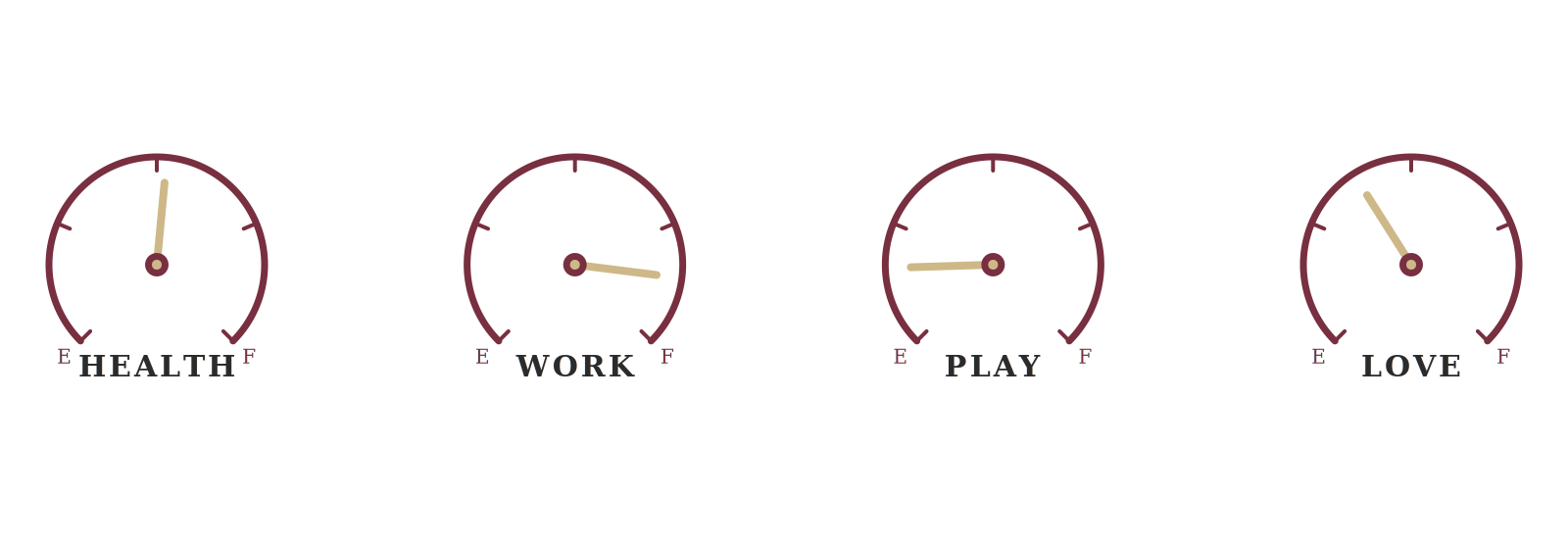
So if you're supposed to start where you are — where are you, exactly? Designers begin every project by honestly assessing the current state, and Burnett and Evans give us a tool for that: the Life Design Dashboard. Picture the dashboard of a car, with four gauges. Each one measures how full the tank is in one area of your life:
Health. Body, mind, and spirit. Are you sleeping? Eating real meals? How's your head — not compared to anyone else, just honestly?
Work. For you right now, work mostly means school — classes, studying, plus any job you hold. Not “am I succeeding” but “how is it actually going?”
Play. Things you do purely because they bring you joy — not for a resume, not to get better at something, just for the thing itself. This is the gauge college students most often let hit empty without noticing.
Love. Not just romance — the whole flow of connection in your life. Family, friends from home, the people you're starting to know here. First semester, this gauge is usually in the middle of a complete rebuild. That's normal, and it's worth seeing clearly.
In class, you'll mark where each of your four gauges sits, from empty to full. Two rules make the dashboard work. First, no judgment: a low gauge is information, not a grade. A designer looking at a low fuel reading doesn't feel ashamed of the car. Second, don't expect symmetry: nobody's life divides into four equal parts, and it isn't supposed to. The dashboard isn't asking you to be balanced. It's asking you to be honest about where you're starting from — because you can't design your way forward from a place you're pretending to be.
Take Marcus, a first-year we made up but who you will probably recognize. His Work gauge reads nearly full — classes are hard but he's on top of them. Health, about half: sleep is a mess but he's basically fine. Play, almost empty: he can't name the last thing he did purely for fun that wasn't scrolling. Love, a quarter: his people are all back home, and the friendships here are still surface-level. Marcus's first instinct is to feel bad about that. But look at what the dashboard actually gave him: in ninety seconds he went from a vague sense that something's off to two specific, workable design problems — play and connection. That is not a crisis. That is a starting point — and finding your starting point is exactly what the dashboard is for.
Watch
Bill Burnett's TEDx talk, “5 Steps to Designing the Life You Want” (about 25 minutes). You'll meet the ideas we use all semester, told by one of the two people who built this framework — including the research on why “just follow your passion” turns out to be terrible advice for most people. Watch the whole thing if you can; it's the closest thing this course has to a lecture, and it's the only one.
Your journal
Get yourself a notebook before class — any notebook. That's your reflection journal for the semester, and no one will ever read it but you. Your first entry happens sometime this week, after our first class. If you want a head start, the prompt is the same question as your honest sentence, at full length: “How's it going — really?” Write for ten minutes without stopping. If you get stuck, walk through the four gauges — health, work, play, love — and write a few honest sentences about each.
Come Ready
Come to class with one honest sentence — your real answer to “How's it going, really?” Write it down — in your journal, on a sticky note, in your phone — and bring it with you. Your first triad conversation opens with each of you sharing that one sentence. It's the first honest thing you'll say to the two people who will spend fifteen weeks helping you design what comes next — so make it true. And one more question to bring with you: of the four gauges you just read about — health, work, play, love — which one of yours is running lowest right now? You'll use that answer at the end of class.
ENT 1611 Designing Your Life · FSU Innovation Hub · Ideas adapted from Bill Burnett & Dave Evans, Designing Your Life (Knopf, 2016) · Worksheets and submissions live on Canvas