


TEAMING
Course Content for ENT3607 Innovation by Design - Syllabus
Design Thinking > How Might We > Team > Plan > Empathize > Synthesize > Ideate > Build > Pitch
Teaming refers to the considerations that are involved in assembling a Design Thinking team.
The dynamics in a Design Thinking team can make or break a project. Careful consideration is given to team make-up based on
team member skills
team member role within the design challenge
team member personality
team member perspective
A team is typically made up of between three and seven members with an ideal number often being five.
Design Thinking is Messy
Design Thinking is a human endeavor and as such can be messy. It is not necessarily a sequential process. “Designers” often find themselves having to retrace their steps, question previous assumptions and learn through the process. Stakeholders are involved in the process continuously serving to validate detailed insights and solutions. Iteration is used at every stage to validate progress and refine solutions to perfection. Occasionally, an entire solution may have to be scrapped after weeks of effort. Or, a team, may decide to pivot to some other solution.
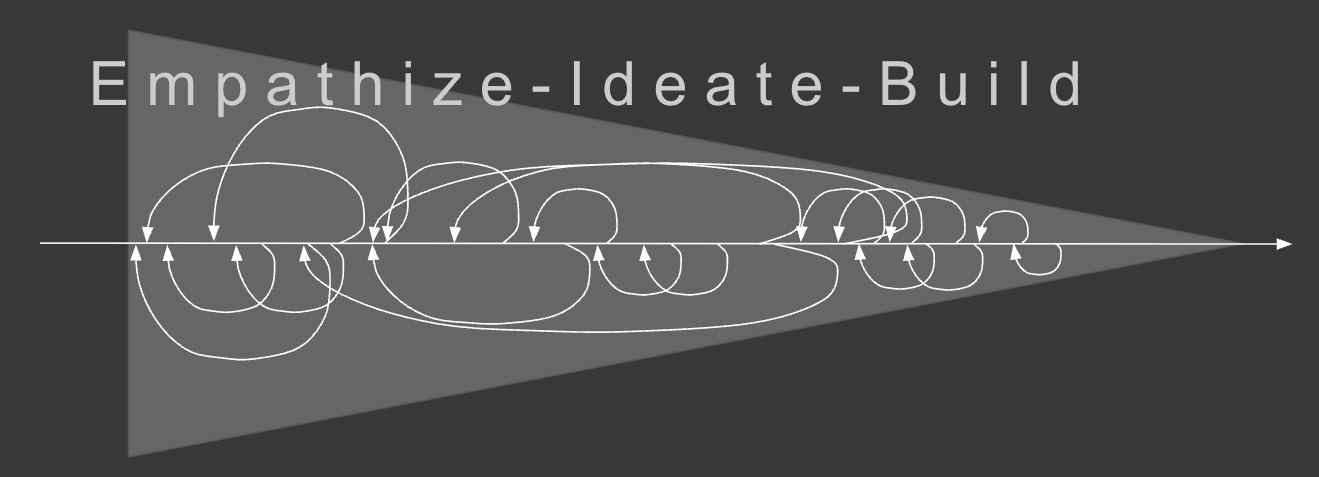
Design Thinking in Detail
While Design Thinking can be viewed as a simple three stage process, there are subdivisions of these stages and additional steps in prep and follow-up that extend it to a ten stage process. Each stage containing several activities. This is why Design Thinking requires a full semester of study.
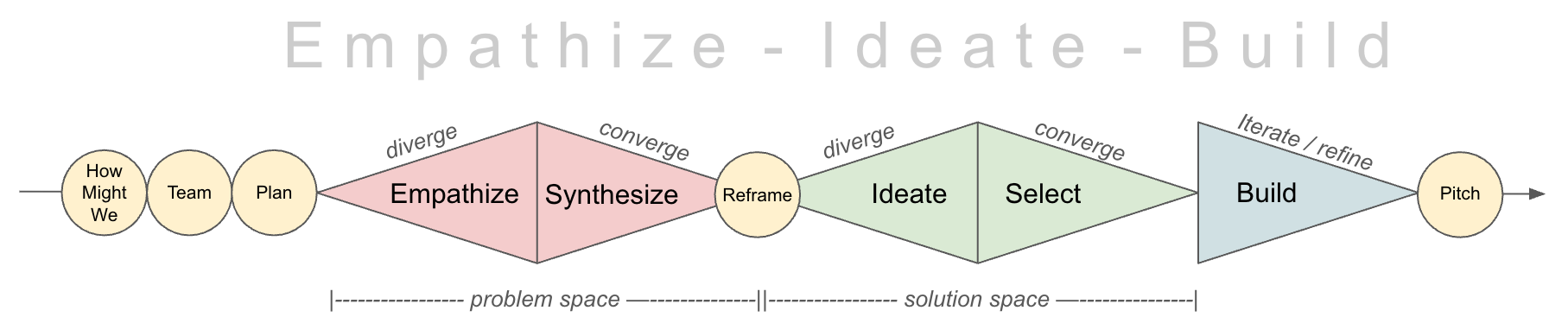
Stages of Design Thinking
-
1. How Might We
Every Design project begins with a design challenge - a problem that must be addressed. This problem is formatted as a How Might We (HMW) question that identifies who you are trying to help, what you are helping them accomplish, for what ultimate goal. Establishing the perfect HMW is an art form unto itself.
-
2. Teaming
Design Thinking relies on the synergy and energy of team work. A Design Thinking Team is ideally made up of five individuals with different perspectives and skills. Great team dynamics may be the most important contributor to innovation.
-
3. Planning
Before beginning the Design Thinking Process, it’s important to understand the context of the challenge, the people involved, and important factors for a successful solution.
-
4. Empathize
After the three previous steps of preparation, the real design work begins. In the Empathy stage the team thoroughly researches the problem from the stakeholders viewpoint prior to considering solutions. Often times unique, key insights gathered in this stage will lead to innovative solutions.
-
5. Synthesize
After collecting insights through empathy research, it’s time to synthesize those insights to discover an area of the problem that is ripe for innovation.
-
6. Reframe
After synthesizing all your empathy research, you should have gained important insights that are ripe for innovation. Reframing allows you to edit the HMW to a specific area of the problem that you intend to address.
-
7. Ideate
Ideation involves utilizing creative activities to come up with many solution ideas from obvious to wild, prior to whittling them down to the best solution in terms of impact and feasibility.
-
8. Selection
Deciding the optimal solution, from a wide array of good solutions, can be the most challenging task in the Design Thinking process. These methods are useful in helping you in the process.
-
9. Build
Building your solution requires an iterative process of prototyping and testing. There are several types of prototypes you can employ to bring your solution out of your head and into the physical world for critique.
-
10. Pitch
Developing your brand and communicating your value clearly, thoroughly, and persuasively in a pitch is the most important step in making your solution a reality.
Design Thinking Materials and Tools
Design Thinking tools allow for teams to work fluidly together and for each person, each insight, and each idea to to be seen and evaluated equally.
Traditional Materials List
3” x 3” Post-It pads
Sharpie fine point black markers
Poster sheets or butcher paper
Expo colored markers
Prototyping materials as needed
Virtual Tools
Miro software and this Design Thinking Template
Activities
-
Design Thinking Crash Course
This exercise uses paper sticky notes, Sharpies, and poster paper.
Work through the stages of Design Thinking - Empathize, Synthesize, Reframe, Ideate, Prototype, and Pitch in a mini 60-minute design sprint.
[08 minutes] Empathize using pair-up interviews on a design challenge
[15 minutes] Pair-up pairs into quartets to synthesize what you learned using an Affinity Map.
[05 minutes] Use your most interesting insite to reframe the How Might We question.
[15 minutes] Ideation Brainstorming and Affinity Mapping to develop solutions
[17 minutes] Prototyping your best solution by developing a poster infographic and Pitch it to the class.
-
Introduction to Miro
Setup an account at https://miro.com/ and login.
The Facilitator should make a copy of this Miro Personality Map. Set the Map to be editable by anyone with the link and share a link with participants.
Learn how to use the virtual sticky note tool to place your name on a sticky note, and place it on the personality map where you feel your personality lies.
Notice the wide range of personalities in the class. Each with something unique to contribute and areas for growth.
Free play with the other tools on the toolbar.
Check your understanding of Design Thinking
What is Design Thinking?
What are the Pillars of Design Thinking?
What are the three general stages of Design Thinking?
T/F Design Thinking is a clean sequential process.
The three stages of Design Thinking are broken down into ___ more details steps.
What is the importance of an HMW?
T/F Design Thinking explores possible solutions prior to Empathy Research.
The two stages in the Problem Space are ________________.
How does a divergent process differ from a convergent process?
What benefit do post-it notes provide to the Design Thinking process?